A TALE OF MARSHMELLOW AND FISH
A TALE OF MARSHMALLOW AND FISH
(FISH GELATINE THE FUTURE OF HALAL GELATINE)
(FISH GELATINE THE FUTURE OF HALAL GELATINE)

 "Hi, I'm marshmallow and this is my friend, Fish and today I want to share something with you... Do you know what I was made from??"
"YESSS!! I was made from gelatine, let us explore what is gelatine" 😉
Gelatine is a multifunctional ingredient in various products mainly foods and pharmaceuticals. When the words gelatine comes out from people’s mouth, the first things that strikes to our minds are jiggling substances produced from animal bovine and having gelling properties. Gelatine production in worldwide are generally made from pig skin and cattle hides and bones. So, let’s take a look on an overview about gelatine in this video!
Source from : https://www.youtube.com/watch?v=l6_erCq7Oso by Edible Evidence published on Dec 1, 2015.
We can see that there are many other studies done make headway to replace the current gelatine into better gelatine properties such as bird feet and insect. Science world is full of surprise! How can we expect that insect can be used as a source of gelatine? However, that is not the main issue discussed right now. The vital issue is how and why the fish gelatine production are spreading over time.
The raw materials in producing gelatines gained attention from the Muslims, Hindu and Jews due to the religious concern. Thus, fish gelatine has been the target of the scientist and industry for a widely acceptable gelatine to be consumed by all religions and other communities such as vegans. Why are we so focussed on this one thing? One example of verses from the Quran on pig consumption:
“He has made unlawful for you that which dies of itself and blood and the flesh of swine and that on which the name of any other than Allah has been invoked. But he who is driven by necessity, being neither disobedient nor exceeding the limit, then surely, Allah is Most Forgiving, Merciful.”—Quran, Al-Baqara 2:173
Incidentally, most people don’t know, but Jews have a line in the Old Testament that prevents them from eating pork as well.
“And the swine, because it divideth the hoof, yet cheweth not the cud, it is unclean unto you: ye shall not eat of their flesh, nor touch their dead carcase.” – Deuteronomy 14:8
The pictures below show an overview of differences between Halal and non-halal gelatine.


Besides, the other reasons why fish gelatine is comprehensively studied is because it gives a solution to the utilization of huge amounts of fish wastes. Researchers main objective is not only improving the gelatine quality but also creating a sustainable world. The by-products generated by the fish-processing industry are a potential source for the production of gelatin. Despite the presence of several valuable components in the fish processing discards, the latter are usually dumped into landfills or at sea, having potentially harmful environmental effects or end up as low commercial value products (e.g., white fish meal). Still, fish processing by-products can be considered as an alternative raw material for the preparation of high-protein ingredients, especially for the production of food grade gelatine due to the presence of large amounts of collagen in fish skins, scales, and bones. The fish gelatine production will eventually optimize completely fish skin and bones thus, helps to save energy.
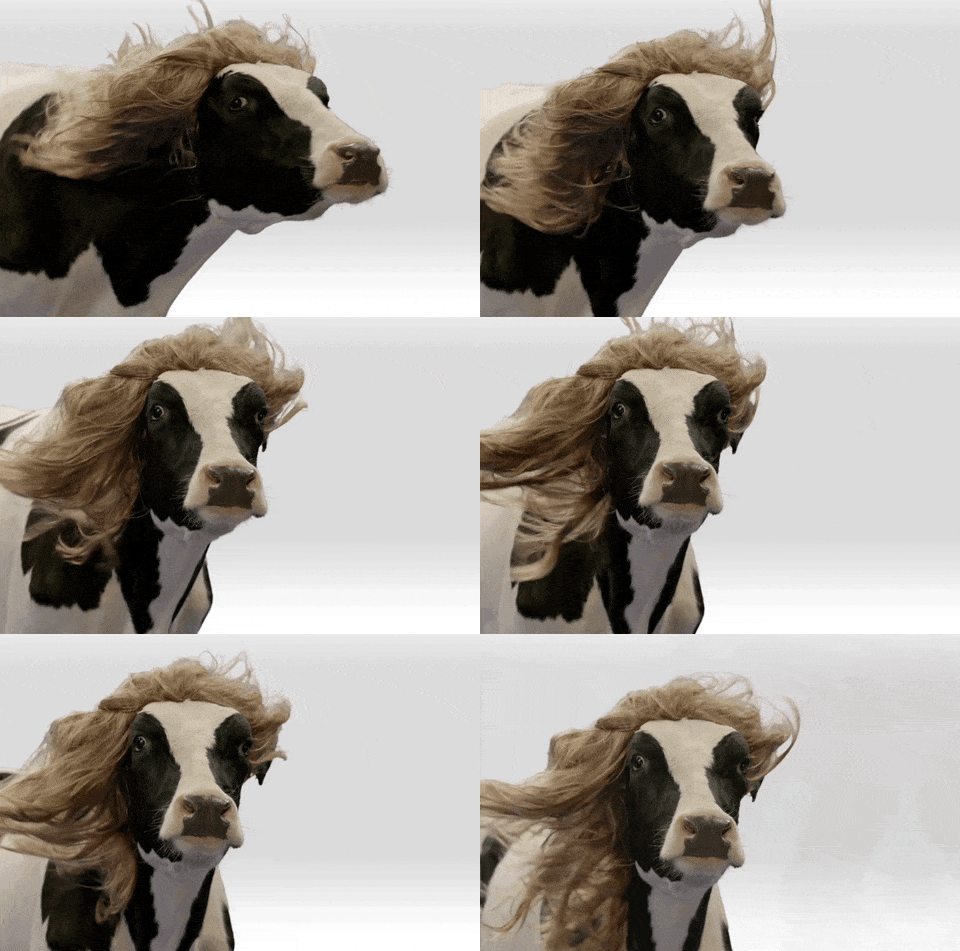
Furthermore, health related issues associated with bovine such as mad cow diseases and foot-and-mouth disease (FMD) further support fish gelatine production that build trust among consumers.
 From all these reasons, do you expect fish gelatine to replace pig skin as the major gelatine production in the world in the next 30 years? Think about the possibilities!

(maybe this is what pig's feel if fish able to replace him!)
So, what is fish gelatine profiles?
Various species of fish can be used to make gelatine. Among them are alaskan pollock skin, yellow-fin tuna, channel catfish skin and many more. The raw materials for gelatine is collagen that can be derived from bone, scales and fins.
 Fish gelatine is obtained from partial hydrolysis of fish skin collagen which can be achieved by direct thermal treatment, use of acidic or alkaline or enzymatic pre-treatments. The degree of collagen cross-linking is a key factor in order to decide the pretreatment process required for gelatine manufacture and is highly dependent on a number of factors such as collagen type, species and age. During extraction, triple helix structure which contributes to the unique properties of collagen should be preserved. Although there are some differences in treatments techniques, fish collagen can have unique gel-forming ability. In general, the amino acid composition of both fish scale and bone is almost similar to fish skin-based gelatine. High content of amino acid in particular hydroxyproline contributed to better gelling properties in their gelatine. Fish gelatine are used widely in food ingredients, feed binding agent and edible films
Uniqueness of fish gelatine?
So, what properties makes fish gelatines unique? The physical properties of the gelatine depend not only on the amino acid composition, but also on the relative content of β- or γ- components and higher molecular weight aggregates, as well as on the presence of lower molecular weight protein fragments.

How about the market value of fish gelatine in today’s industry?


The resultant gelatines in the market were evaluated in terms of extraction yield, amino acid composition, molecular weight distribution, gel strength, viscoelastic properties, ability to refold into triple helical structures, and aggregation phenomena.

 The market value of fish gelatine is still growing and many investments have been made on the research and development (R&D) to strategized the production and market values. About 30% of the wastes consists of skin and bone with a high collagen content. Although fish gelatine is an alternative to the commercially available mammalian gelatines, its production on a large commercial scale has been hampered, mainly, due to the inferior quality characteristics compared to its mammalian counterparts. In the Halal and Kosher market, it is hopeful that one day fish gelatine could meet the demand of the global market required.
Among commercial examples of fish gelatine in the market is from Jellice Pioneer in Europe. The gelatine is extracted from the fish skins of tilapia and pangasius. In Malaysia, Halagel is one of the main supplier of halal gelatine worldwide including gelatine from fish source.
Conclusions?

I think that is enough of explain and here’s the main topic on what has been discussed generally in the production of fish gelatine.


This comment has been removed by the author.
ReplyDeleteThis comment has been removed by the author.
ReplyDelete